English
 Arabic
 French
 Spanish
 Portuguese
 Deutsch
 Turkish
 Dutch
 Italiano
 Russian
 Romaian
 Portuguese (Brazil)
 Greek
Alien Doctor Love Story: A Medical Sci-Fi Romance Beyond the Stars
Other |
2026-09-28 17:53:16
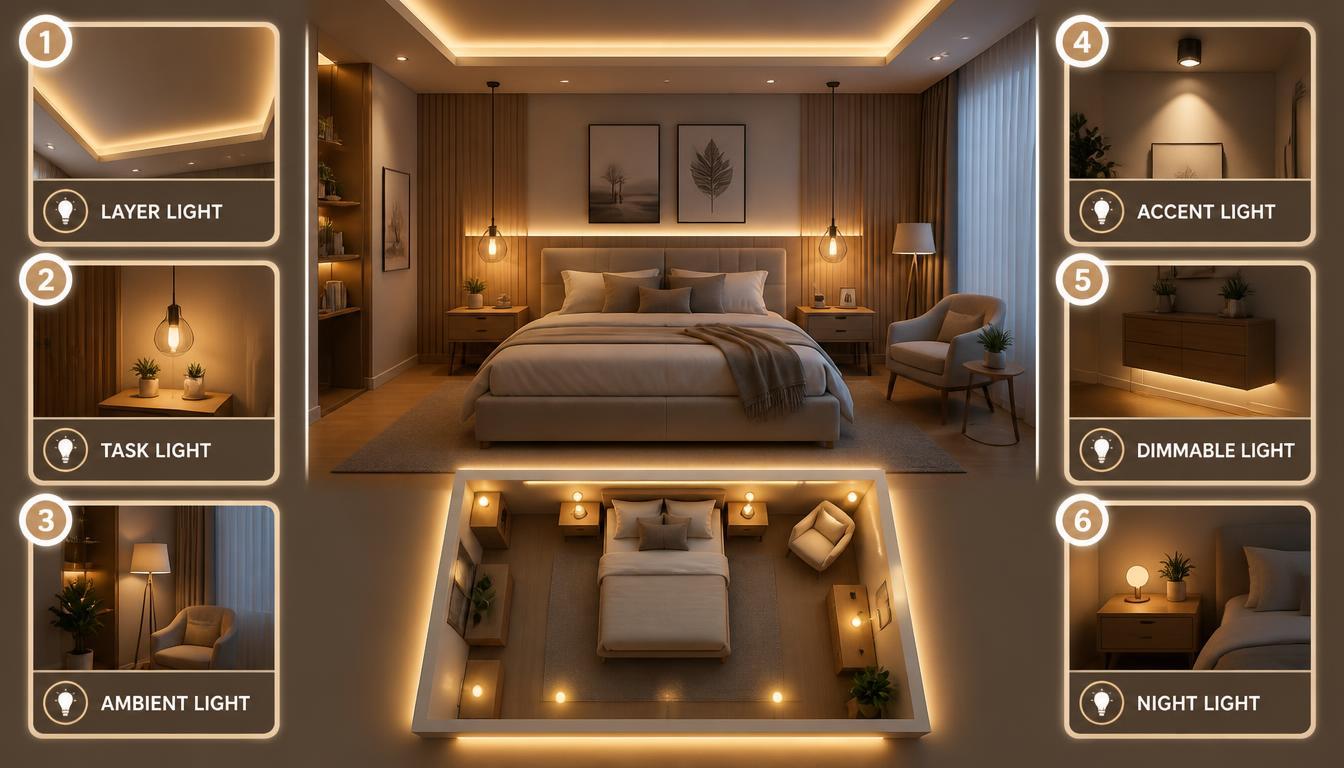
An important element of bedroom lighting is peaceful lighting. An effective lighting plan can affect the mood of the bedroom while helping with different activities like reading, dressing, or sleeping.
There are no secrets in this case: it is all about understanding where lighting is needed and how brightly light must be provided. Also, when it should come from each particular light source.
Every part of the bedroom has to be sufficiently lit according to its functions. But it should not have the same amount of light in all areas.
Divide the room into practical zones:
Bed area for reading and nighttime movement
Dressing area for clothing and personal care
General area for daytime tasks
Decorative areas for artwork or architectural features
It also becomes possible to come up with a more efficient bedroom lighting design because the function of each light source can be achieved by virtue of the particular design. Having separate switches is seen to be an asset when it comes to having different areas in the room illuminated.
Yes, evening bedroom lighting does indeed impact the signals for melatonin. The effect of evening light on the secretion of melatonin is conditioned by various factors, as the reactions vary depending on:
level of intensity
length of exposure
spectral composition
duration of exposure
individual traits.
An experiment was conducted in which 116 participants aged 18-30 took part. They were exposed to either a regular room light or a dim light before going to bed.
The room-light condition used less than 200 lux. Compared with dim light below three lux, it delayed melatonin onset in 99 percent of participants.
Melatonin production also became approximately 90 minutes shorter under room light. The discovery validates the importance of minimizing unnecessary bright light before sleeping.
In general, it is better to use warm light in your bedroom in the evening.
According to the U.S. Department of Energy:
|
CCT |
Visual Appearance |
Suitable Bedroom Application |
|
2700K |
Warm white |
Evening relaxation |
|
3000K |
Soft warm white |
General illumination |
|
3500K |
Neutral white |
Dressing tasks |
|
4100K |
Cool white |
Detailed visual work |
Note that color temperature alone does not tell the complete biological story.
Fixture arrangement issues consist of reflections, shadows, and lack of light. An aesthetically pleasing fixture can quickly become irritating when its luminous area is in the person’s vision.
To achieve a relaxing bedroom ambiance, indirect light from ceilings and walls can illuminate a room without sharp transitions in brightness.
It is also advisable to position fixtures close to the bed but not in the line of sight. The light beam must be directed towards the book rather than the person’s head.
Use hidden or diffused light placed near wardrobes and dressing areas. There should be no distraction of light while one is in proximity to the cupboards.
Bedside lighting should leave enough space for books, glasses, and other objects.
When comparing different LED devices, one should pay attention to wattage. The light output of the device is influenced by:
Lumens,
Color temperature
Color rendering index
Compatibility with dimmers
Design of the luminaires.
Lumen refers to the light output, while lux is used to refer to the illuminance received by a surface area; therefore, none of the two measurements is sufficient enough to describe the whole picture.
According to the Department of Energy, there should be at least 80 CRI in bedroom lighting fixtures. According to DOE, CRIs above 90 are rated as excellent.
Color fidelity is important during the selection of clothing or fabric. It could also be helpful in making the color of the decorative finish match its intended look.
LED performance can also depend on the luminaire design and the efficiency of the power supply source used.
Circ Lighting can be included in this selection process where both decorative and functional fixtures will be compared. Size, light output, and installation requirements should be considered.
Controls give one fixture several useful roles. A dimmer can provide stronger illumination during dressing and softer output during quiet activities.
Check compatibility before pairing LED lamps with dimmers. The Department of Energy recommends confirming that the lamp supports the selected dimming system.
Tunable products can also change color appearance. DOE explains that some systems allow users to adjust light intensity and color through integrated controls.
For ambient lighting, separate controls are especially useful. You can keep subtle illumination active without turning on stronger task fixtures.
A practical evening sequence might look like this:
1. Use stronger illumination while dressing.
2. Turn off fixtures serving finished tasks.
3. Keep focused light available for reading.
4. Reduce brightness during quiet activities.
5. Turn off unnecessary sources before sleeping.
This creates a flexible bedroom lighting system without requiring a complicated installation.
Glare deserves attention because brightness alone does not determine visual comfort. The Department of Energy defines glare as a high level of brightness affecting vision.
The key aspect of fixture placement is the fact that the impact of glare depends in part on the position of the light source. This is relative to the visual subject. Thus, the use of shielded lamps may ensure added comfort.
Flicker is yet another important feature that one should check. According to the DOE, fluctuations in intensity may lead to certain visual effects, from annoying to irritating.
One might easily miss these points when making a choice of fixtures by using pictures. If possible, check the light source beforehand.
The way of having a cozy bedroom is achieved through lighting which must be according to your lifestyle. Bedroom lighting can be achieved through proper color, proper lighting intensity, proper location, and convenient on-off switching. Begin with the bed and dressing areas. After this, make adjustments to glare and the direction in which the lights are fixed, as per the nature of the room at night.