English
 Arabic
 French
 Spanish
 Portuguese
 Deutsch
 Turkish
 Dutch
 Italiano
 Russian
 Romaian
 Portuguese (Brazil)
 Greek
A Practical Look at Saudi Kandura Styles for Men
Shopping |
2026-11-13 06:21:30
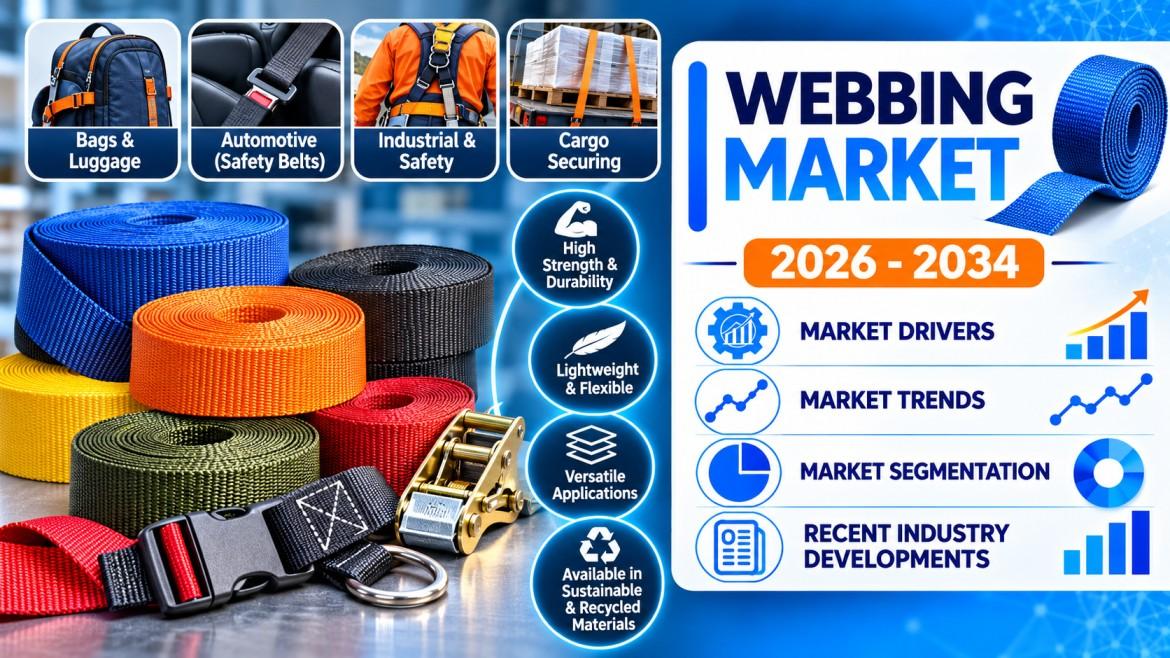
IMARC Group, a leading global market research and management consulting firm, has published its latest market intelligence report on the webbing market. The global webbing market grew from USD 4.5 Billion in 2025 to USD 4.8 Billion in 2026. Looking forward, IMARC Group expects the market to reach USD 7.0 Billion by 2034, exhibiting a growth rate (CAGR) of 4.89% during 2026-2034. Growth is driven by regulatory mandates for vehicle restraint systems, rising defense and aerospace demand for high-strength load-bearing textiles, the expansion of e-commerce packaging and cargo securing, and continuous material innovation in aramid, UHMWPE and recycled fibers.
The market is experiencing strong growth momentum as webbing moves from a commodity textile to an engineered safety component. Narrow woven fabrics are now specified for seatbelts, parachute risers, fall-protection harnesses, tactical gear, climbing equipment and cargo tie-downs, where failure is not an option. Polyester remains the largest material segment because of its balance of strength, UV resistance and cost. Premium fibers such as p-aramid, carbon and UHMWPE are gaining ground in applications where weight savings and tensile performance command higher prices. Automotive is the largest application segment, and Asia Pacific is the largest regional market.
Grab a sample PDF of this report: https://www.imarcgroup.com/webbing-market/requestsample
Regulation is the structural base of automotive demand. Every passenger vehicle needs certified restraint webbing, and governments are tightening the rules. In India, the Ministry of Road Transport and Highways published a draft in August 2024 that proposed seat belt reminders for front-facing rear seats in passenger cars. It also called for upgraded safety-belt assemblies and anchorages aligned with IS 15140, IS 15139 and IS 16694 across passenger cars, quadricycles, buses and heavy goods vehicles. The case for stricter rules is visible in the ministry's own road accident data, which recorded more than 16,700 deaths linked to non-use of seat belts in a single year, split almost evenly between drivers and passengers. Rules that extend belt coverage to more seats and more vehicle classes raise webbing consumption per vehicle, and they favor suppliers with certified, high-tenacity polyester production.
Defense and aerospace are shifting demand toward advanced fibers. In the United States, the Berry Amendment requires the Department of Defense to buy certain textiles that are made domestically, which supports specialist mills that weave to MIL and PIA specifications. Bally Ribbon Mills markets 100% Berry-compliant webbing in widths from one quarter inch to six inches for aircraft seat belts, harnesses, tie-downs and load-bearing systems. Parachute programs show how demanding these applications are, with webbing made from nylon, Kevlar, Vectran, PTFE and Zylon used in canopy reinforcements, harnesses and risers, and in space launch and capsule recovery systems. Fibers that deliver more strength at lower weight are now commercially important. Webbing made with Kevlar EXO is reported to deliver 40% to 50% higher tenacity than legacy Kevlar webbing, with weight savings of 15% to 40% at equivalent strength targets.
Aftermarket services and sustainability are creating new revenue pools. Re-webbing, which replaces worn webbing while keeping airworthy buckles and fittings, is gaining traction in aviation. It lets operators avoid long replacement lead times and reduces waste. E-commerce and logistics are adding steady volumes for cargo straps, load-securing belts and heavy-duty packaging tapes. Outdoor recreation, sporting goods and fashion accessories widen the demand base further. Recycled polyester and biodegradable material options are an additional growth path for suppliers responding to buyer sustainability requirements. Raw material price volatility and regulatory compliance remain the main challenges, and they favor scaled manufacturers with strong testing and certification capabilities.
Ask an analyst for customized report: https://www.imarcgroup.com/request?type=report&id=3886&flag=E
The report has segmented the market into the following categories:
Breakup By Product:
Polyester accounts for the largest product segment, supported by its high tensile strength, low stretch, resistance to UV and moisture, and cost efficiency, which make it the default choice for automotive seatbelts, cargo straps and industrial slings. Nylon retains strong positions where energy absorption is critical, while aramid, carbon and UHMWPE webbing are expanding in military, aerospace and high-performance protective uses.
Breakup By Application:
Automotive is the largest application segment, driven by mandatory seatbelt and restraint system requirements, rising vehicle production and ongoing safety standard upgrades. Sporting goods benefit from climbing, outdoor and fitness participation, while industrial users depend on webbing for lifting slings, fall protection and load securing. Military demand relies on durable, standards-compliant load-bearing equipment.
Breakup By Region:
Asia Pacific dominates the global webbing market with the largest regional share, supported by large-scale manufacturing and automotive production, expanding industrialization, a vast consumer base and fast-growing e-commerce packaging demand. North America is a fast-growing market on the back of automotive, aerospace and outdoor recreation industries. Europe is a mature market anchored by its well-established automotive sector. Latin America is growing steadily, led by automotive and industrial demand in Brazil and Mexico, while the Middle East and Africa is an emerging region driven by construction and infrastructure.
The report provides a comprehensive analysis of the competitive landscape in the webbing market with detailed profiles of major companies, including:
(Note: This is only a partial list of key players, and the complete list is provided in the report.)
If you are tracking the webbing market for investment decisions, market entry planning, competitive benchmarking or strategic advisory, IMARC Group's report gives you everything in one place:
Note: If you require specific details, data or insights that are not currently included in the scope of this report, we are happy to accommodate your request. As part of our customization service, we will gather and provide the additional information you need, tailored to your specific requirements. Please let us know your exact needs, and we will ensure the report is updated accordingly to meet your expectations.
IMARC Group is a global management consulting firm that helps the world's most ambitious changemakers to create a lasting impact. The company provides a comprehensive suite of market entry and expansion services. IMARC offerings include thorough market assessment, feasibility studies, company incorporation assistance, factory setup support, regulatory approvals and licensing navigation, branding, marketing and sales strategies, competitive landscape and benchmarking analyses, pricing and cost research, and procurement research.
IMARC Group
Email: sales@imarcgroup.com
United States: +1-201-971-6302
India: +91-120-433-0800
United Kingdom: +44-753-714-6104