English
 Arabic
 French
 Spanish
 Portuguese
 Deutsch
 Turkish
 Dutch
 Italiano
 Russian
 Romaian
 Portuguese (Brazil)
 Greek
iPhone Screen Repair Near Me: What to Know Before Fixing Your Screen
Crafts |
2026-10-20 18:22:34
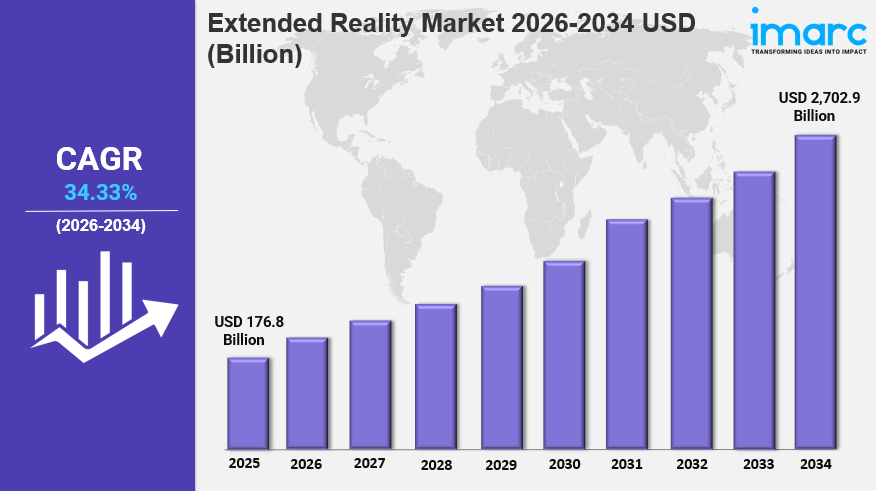
IMARC Group has recently released a new research study titled "Extended Reality Market Report by Component, Type, Organization Size, Application, End User Industry, and Region 2026-2034," which offers a detailed analysis of the market drivers, segmentation, growth opportunities, trends and competitive landscape to understand the current and future market scenarios.
The global extended reality market size grew from USD 176.8 Billion in 2025 to USD 254.9 Billion in 2026 and is projected to reach USD 2,702.9 Billion by 2034, exhibiting a compound annual growth rate (CAGR) of 34.33% during 2026-2034. This rapid extended reality market growth, supported by a strong extended reality market forecast, is primarily propelled by rising consumer awareness and acceptance of XR technologies, the growing adoption of cultural heritage preservation and virtual museums, and the expanding use of military and defense applications for training and simulations.
Base Year: 2025
Historical Years: 2020–2025
Forecast Period: 2026–2034
Market Size (2025): USD 176.8 Billion
Market Size (2026): USD 254.9 Billion
Projected Size (2034): USD 2,702.9 Billion
Growth Rate: CAGR of 34.33%
Explore Growth Opportunities in the Extended Reality Industry – Grab Your Sample Report for Evaluation: https://www.imarcgroup.com/extended-reality-market/requestsample
Extended reality (XR) is an umbrella term for virtual reality (VR), augmented reality (AR) and mixed reality (MR) technologies that blend the physical and digital worlds. Gaming, entertainment, healthcare, education, retail and industrial users rely on these immersive solutions for training, visualization, collaboration and customer engagement. These factors are shaping extended reality market trends, while the integration of artificial intelligence (AI) and the arrival of more affordable devices continue to widen the scope for innovation across the industry.
Key Market Trends:
• Rising Availability and Affordability of XR Devices: Technology advancements, economies of scale and stronger competition have made XR solutions more accessible, with AR-ready smartphones and lower-cost standalone VR headsets widening the user base.
• Rising Use in Retail and E-Commerce: Virtual product visualization, virtual try-on and interactive displays help shoppers picture products in their own spaces, boosting purchase confidence and creating distinctive customer journeys for retailers.
• Growing Demand for Marketing and Advertising Campaigns: Brands are using interactive AR advertisements, branded VR environments and MR experiences to improve customer engagement and brand recall.
• AI-Driven Interactivity and Content Creation: As highlighted in the extended reality market analysis, AI-based object detection, natural language comprehension and generative 3D content tools are making XR experiences more realistic, personalized and cost-effective to produce.
Several factors are fueling extended reality market growth, and understanding them is essential for companies aiming to benefit from the rising extended reality market size. The adoption of immersive solutions across industries is shaped by the following drivers.
Key Growth Drivers:
1. Rising Adoption of Immersive Technologies: Expanding use of XR in gaming, entertainment, healthcare and education is boosting extended reality market demand.
2. Enterprise and Industrial Applications: Manufacturers, healthcare providers and real estate firms use VR simulations for safe, cost-effective training and AR for real-time guidance during maintenance and assembly, with VR training shown to increase speed to competence by 52%.
3. Military, Defense and Cultural Applications: Simulation-based training for defense personnel and virtual museums for cultural heritage preservation are opening new avenues for XR deployment.
4. Integration of Artificial Intelligence: AI-supported spatial mapping, adaptive training scenarios and faster 3D content generation are making XR more scalable, supporting sustained extended reality market growth.
Strategic Insights:
• Invest in Affordable, User-Friendly Hardware: A favorable extended reality market forecast makes this a good time to address high device costs, bulky designs and motion sickness, which are the main barriers to mass adoption.
• Embed XR into Enterprise Workflows: Integrating AR, VR and MR into training, maintenance and design processes helps vendors capture a larger portion of the rising extended reality market size.
• Prioritize High-Engagement Use Cases: A strong presence in media and entertainment, retail and marketing, where consumer engagement is high, strengthens extended reality market share.
With the market expected to climb from USD 176.8 Billion in 2025 to USD 254.9 Billion in 2026 and USD 2,702.9 Billion by 2034, and the extended reality market analysis pointing to a CAGR of 34.33%, stakeholders see a compelling opportunity. Sustained expansion, backed by rising extended reality market demand across gaming, healthcare, education and industrial sectors, is encouraging investment across the value chain.
Reasons for Investment:
• Broad Industry Adoption: Growing use across gaming, entertainment, healthcare, education, retail and manufacturing is strengthening extended reality market demand and widening the customer base.
• Clear Segment Leaders: Consumer engagement, VR and media and entertainment lead their respective segments, and a detailed extended reality market analysis shows where revenue is concentrating.
• North American Leadership: Early adoption, technological advancement and a strong ecosystem of XR companies and developers give the region the largest extended reality market share.
• Untapped Opportunities: Industrial training, virtual events and immersive storytelling offer room for innovation, while ongoing improvements in hardware cost and usability continue to shape extended reality market trends.
IMARC Group provides an analysis of the key extended reality market trends in each segment, along with an extended reality market forecast at the global, regional and country levels for 2026-2034. The report categorizes the market based on component, type, organization size, application, end user industry and region.
Component Insights:
• Hardware
• Software
• Services
Type Insights:
• Consumer Engagement
• Business Engagement
Organization Size Insights:
• Small and Medium-sized Enterprises
• Large Enterprises
Application Insights:
• Virtual Reality (VR)
• Augmented Reality (AR)
• Mixed Reality (MR)
End User Industry Insights:
• Education
• Retail
• Industrial and Manufacturing
• Healthcare
• Media and Entertainment
• Others
Regional Insights:
• North America (United States and Canada)
• Asia-Pacific (China, Japan, India, South Korea, Australia, Indonesia and Others)
• Europe (Germany, France, United Kingdom, Italy, Spain, Russia and Others)
• Latin America (Brazil, Mexico and Others)
• Middle East and Africa
Speak to an Analyst: For a deeper analysis of the industry, connect with our analysts: https://www.imarcgroup.com/request?type=report&id=4923&flag=C
Leading companies compete for extended reality market share, and the report offers a comprehensive review of the competitive landscape, covering market structure, key player positioning, top winning strategies, a competitive dashboard and a company evaluation quadrant. Detailed profiles are provided for major players such as Apple Inc., AugRay LLC, Dassault Systèmes, Magic Leap, Inc., Qualcomm Technologies, Inc., Softengi, SoftServe Inc., SphereGen Technologies LLC, Theorem Solutions, Varjo and VertexPlus Technologies Limited.
Author IMARC Group
IMARC Group is a leading market research company dedicated to providing data-driven insights and expert consulting services to support businesses in achieving their strategic objectives across diverse industries.
Contact Us
IMARC Group
Email: sales@imarcgroup.com
United States: +1-201-971-6302