English
 Arabic
 French
 Spanish
 Portuguese
 Deutsch
 Turkish
 Dutch
 Italiano
 Russian
 Romaian
 Portuguese (Brazil)
 Greek
Breaking: The Small Business Accounting Software Market is Set for Major Expansion
Networking |
2026-10-07 06:48:19
Detailed Market Analysis and Trend Evaluation
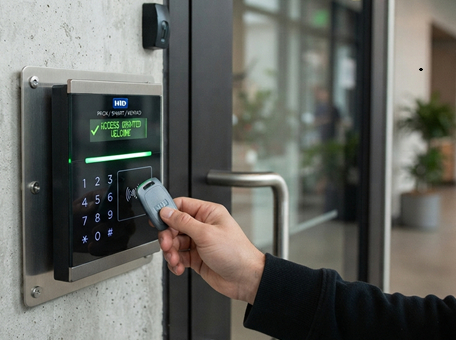
The Access Control Reader Market Analysis presented here provides detailed examination of the trends, drivers, and dynamics shaping this essential security hardware sector. This thorough analysis explores the complex interplay of technological innovation, security requirements, and user expectations that collectively determine market direction and vendor performance. Stakeholders seeking to understand market dynamics and identify opportunities will find valuable insights into the forces driving change across the access control reader technology landscape. The analysis encompasses multiple dimensions including technology trends, communication protocol evolution, credential type shifts, and power source considerations that influence market evolution and create opportunities for value creation across diverse sectors of the physical security industry.
Biometric Integration Transforming Reader Capabilities
Biometric integration represents a transformative trend within the access control reader market, enabling identification capabilities that significantly enhance security and user convenience. Fingerprint readers offer mature, cost-effective biometric authentication suitable for high-volume applications. Facial recognition readers enable touchless authentication that improves hygiene while supporting integration with video surveillance. Multi-modal biometric readers combine multiple characteristics for enhanced reliability in high-security applications. These biometric capabilities address limitations of credential-based systems, which can be lost, shared, or duplicated. Organizations increasingly evaluate readers based on biometric capabilities alongside traditional credential support. Continued advancement in sensor accuracy, processing speed, and anti-spoofing capabilities expands application possibilities while reducing costs, making biometric readers accessible to broader markets.
Mobile Access Solutions Reshaping User Expectations
Mobile access solutions are reshaping user expectations within the access control reader market, with smartphones increasingly serving as primary credentials. Bluetooth and near-field communication technologies enable secure credential presentation from mobile devices, while biometric authentication on phones adds security layers. Mobile credential adoption improves user convenience by eliminating the need to carry separate access cards while enabling remote provisioning and revocation. Readers increasingly incorporate mobile credential support alongside traditional card capabilities, enabling organizations to transition gradually. Integration with mobile wallet platforms and digital identity initiatives positions smartphones as comprehensive identity tools. This trend reflects broader digitization of daily life, where users expect convenient, digital-first experiences across all interactions including building access.
Communication Protocol Evolution Enabling New Capabilities
Communication protocol evolution is enabling new capabilities within the access control reader market, with modern protocols supporting enhanced security, flexibility, and integration. Wiegand protocol maintains dominance due to its established reliability and widespread adoption, though it faces limitations in supporting advanced features. Bluetooth Low Energy enables mobile credential communication while supporting configuration and firmware updates. Internet Protocol connectivity allows readers to integrate directly with network infrastructure, enabling cloud management and advanced analytics. LoRaWAN supports long-range, low-power communication suitable for large-scale deployments. These protocol options create flexibility for addressing diverse application requirements while supporting migration from legacy systems to modern architectures that enable advanced capabilities.
Power Source Considerations Shaping Installation Flexibility
Power source considerations shape installation flexibility within the access control reader market, with different options addressing varied deployment scenarios. Battery-powered readers offer installation flexibility for locations where wiring is impractical, making them suitable for remote or temporary installations. Wired readers using Power over Ethernet or traditional power supplies provide reliability and support advanced features requiring continuous power. Solar-powered readers enable deployment in locations without electrical infrastructure, supporting sustainability objectives while addressing remote applications. Power source selection influences total cost of ownership, with battery-powered readers requiring periodic maintenance while wired readers involve higher initial installation costs. These options enable organizations to select readers appropriate for their specific installation requirements and operational constraints.
➤ Featured Insights from Market Research Future:
Transportation Analytic Market