English
 Arabic
 French
 Spanish
 Portuguese
 Deutsch
 Turkish
 Dutch
 Italiano
 Russian
 Romaian
 Portuguese (Brazil)
 Greek
Saudi Arabia Logistics Market Analysis by Model, Transport Mode and End Use 2026-2034
Other |
2026-11-17 05:58:33
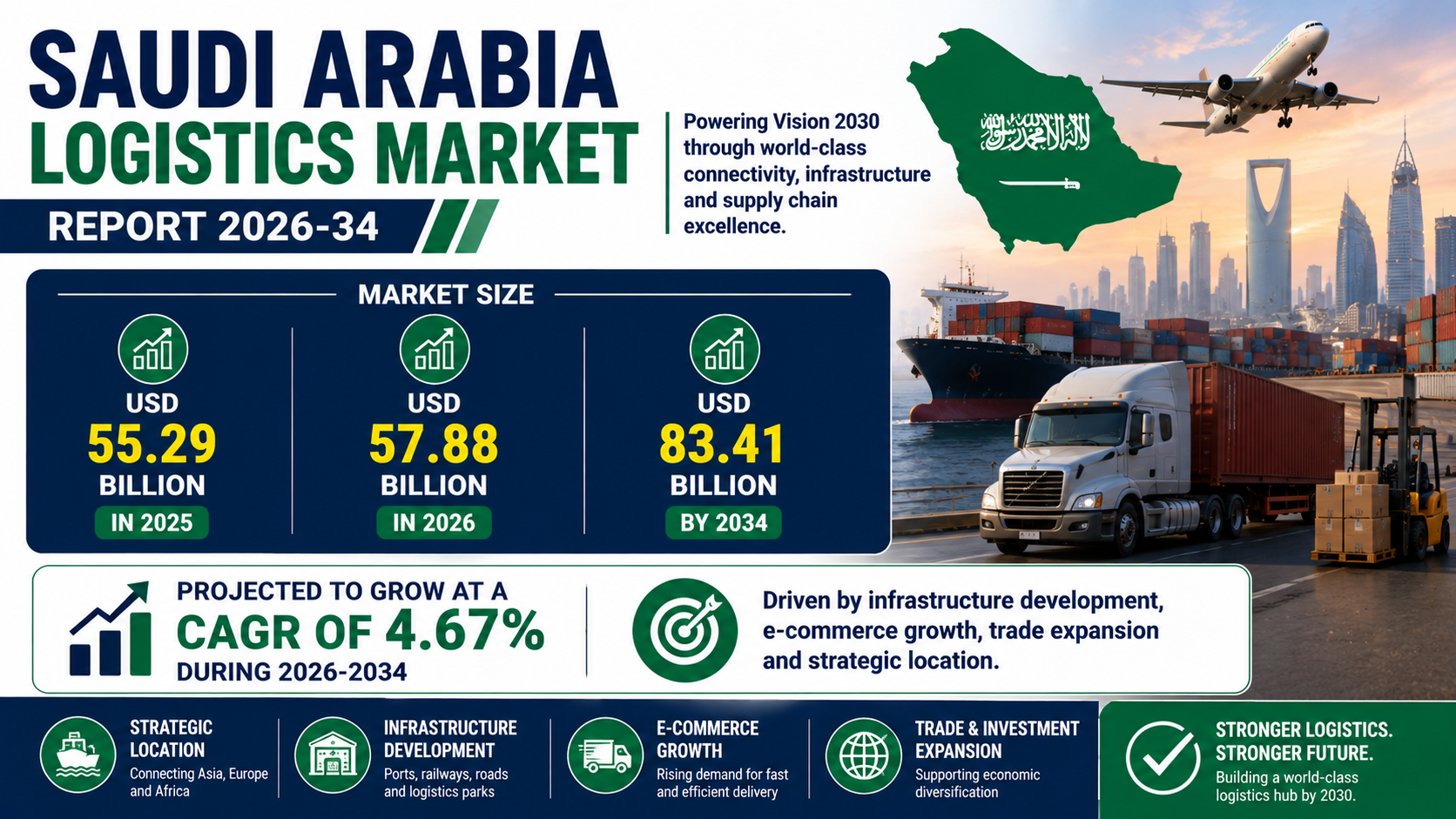
Large-scale Vision 2030 infrastructure investments, rapid e-commerce expansion, and the Kingdom’s strategic position as a trade corridor linking Asia, Europe, and Africa are driving demand for integrated freight, warehousing, and last-mile delivery services. Saudi Arabia logistics market size increased from USD 55.29 Billion in 2025 to USD 57.88 Billion in 2026 and is projected to reach USD 83.41 Billion by 2034, exhibiting a CAGR of 4.67% during 2026-2034. Additionally, the rollout of logistics centers, special economic zones, and rail corridors continues to improve multimodal connectivity and attract global operators.
How AI is Reshaping the Future of Saudi Arabia Logistics Market?
Grab a sample PDF of this report: https://www.imarcgroup.com/saudi-arabia-logistics-market/requestsample
Market Growth Factors
The Saudi Arabia logistics market is driven by the government’s push to make transport and logistics a growth sector in its own right. The National Transport and Logistics Strategy aims to raise the sector’s contribution to GDP from 6% to 10%, achieve a top-10 global ranking in the World Bank Logistics Performance Index, and build more than 4.5 million tonnes of annual air cargo capacity. Progress is visible in the Kingdom’s 17-place climb to 38th among 160 countries in the index, in Mawani ports handling 8.32 million TEUs, up 10.58% year on year, and in private sector investment agreements in transport and logistics exceeding SAR 280 billion (around USD 74.7 Billion). The Logistics Centers Master Plan adds 59 logistics centers covering more than 100 million square meters, with 12 in Riyadh, 12 in Makkah, and 17 in the Eastern Region, creating sustained demand for warehousing, freight forwarding, and contract logistics.
Special economic zones and investment incentives are widening the opportunity for international operators. Four Special Economic Zones, at King Abdullah Economic City, Jazan, Ras Al-Khair, and KACST in Riyadh, offer a 5% corporate income tax rate for up to 20 years, customs duty exemptions, and 100% foreign ownership, and secured USD 12.6 Billion in early investments. The Riyadh Special Integrated Logistics Zone offers a 50-year tax holiday and four-hour customs clearance. The Global Supply Chain Resilience Initiative targets SAR 40 billion (around USD 10.6 Billion) of supply chain investments backed by a SAR 10 billion incentive budget. Together, these schemes are drawing regional distribution hubs from global names such as DHL, Maersk, and Agility.
Multimodal expansion and rising outsourcing are reshaping how goods move across the Kingdom. The Saudi Landbridge, a rail line of about 1,500 kilometers linking Jeddah on the Red Sea with Dammam and Jubail on the Arabian Gulf, carries an estimated cost of up to SAR 100 billion (around USD 26.7 Billion) and includes seven logistics hubs, with the aim of lifting rail’s share of transport to 30%. Roadways still carry 59.08% of the market through a 73,000 kilometer highway network, while 3PL providers hold 46.12% as enterprises outsource warehousing, transportation, and last-mile services. Growing e-commerce, expanding manufacturing clusters, and mega-event preparation for Expo 2030 and the FIFA World Cup 2034 further reinforce demand for ports, airports, and freight corridors.
Market Segmentation
Model Type Insights:
3 PL leads the segment with a 46.12% share, followed by 2 PL at 33.58% and 4 PL at 20.30%, as enterprises outsource integrated transportation, warehousing, and value-added services.
Transportation Mode Insights:
Roadways dominate with a 59.08% share, supported by the extensive highway network and the flexibility of door-to-door trucking. Seaways account for 16.42%, railways 13.75%, and airways 10.75%.
End Use Insights:
Manufacturing is the largest end use segment with an 18.07% share.
Regional Insights:
The Northern and Central Region leads with a 38.0% share, anchored by Riyadh’s role as the economic capital. The Western Region follows with 27.4%, the Eastern Region with 20.6%, and the Southern Region with 14.0%.
Competitive Landscape
Key players in the market include:
Recent Development & News
If you require any specific information that is not covered currently within the scope of the report, we will provide the same as a part of the customization.
About Us
IMARC Group is a global management consulting firm that helps the world’s most ambitious changemakers to create a lasting impact. The company provide a comprehensive suite of market entry and expansion services. IMARC offerings include thorough market assessment, feasibility studies, company incorporation assistance, factory setup support, regulatory approvals and licensing navigation, branding, marketing and sales strategies, competitive landscape and benchmarking analyses, pricing and cost research, and procurement research.
Contact Us
IMARC Group,
134 N 4th St. Brooklyn, NY 11249, USA,
Email: sales@imarcgroup.com,
Tel No: (D) +91 120 433 0800,
United States: +1-201971-6302