English
 Arabic
 French
 Spanish
 Portuguese
 Deutsch
 Turkish
 Dutch
 Italiano
 Russian
 Romaian
 Portuguese (Brazil)
 Greek
Cold-Chain Logistics and Cryopreservation in the Leukapheresis Products Market
Wellness |
2026-10-23 05:31:56
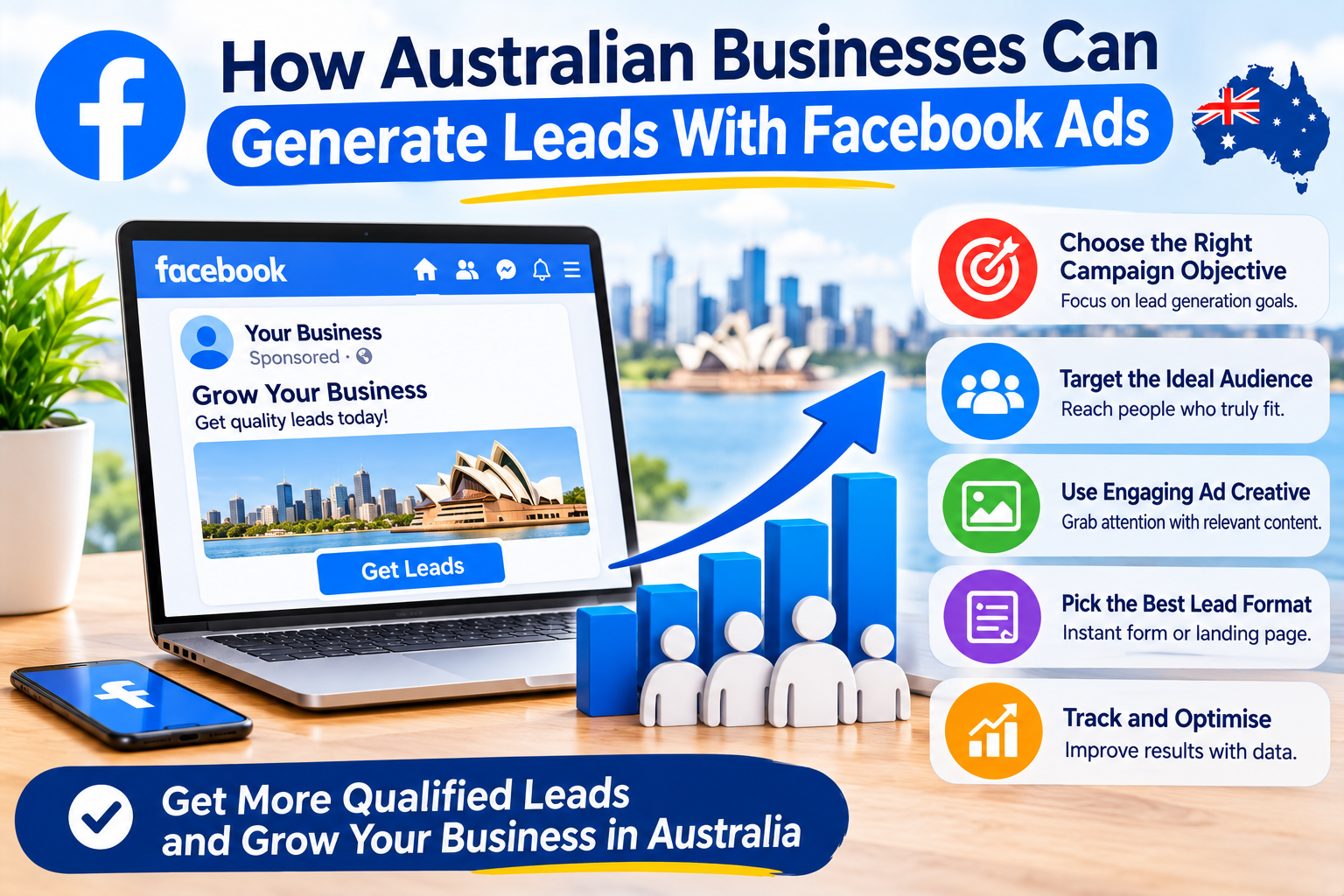
Facebook, alongside Instagram, remains one of the most widely used platforms in Australia, with millions of Australians scrolling through their feeds daily. For businesses willing to approach it strategically, that scale represents a genuine opportunity to generate leads — not by waiting for people to search, but by proactively placing a relevant offer in front of exactly the kind of person likely to want it.
Unlike Google Ads, where the work centres on capturing existing search demand, Facebook Ads succeeds or fails based on how well a business understands its audience and crafts something genuinely worth stopping to look at. This guide walks through the practical mechanics of building a Facebook lead generation strategy that works for Australian businesses specifically.
Understanding What Facebook Ads Does Well
Facebook Ads excels at reaching people based on who they are, rather than what they're actively searching for. Using demographic data, interests, behaviours, and connections to existing customers, Facebook can place an ad in front of a highly specific audience likely to have genuine interest in a product or service, even if none of them happened to search for it that day.
This makes Facebook particularly effective for businesses with visually appealing offers, products or services that benefit from demonstration or storytelling, and businesses targeting a specific demographic or interest group that can be clearly defined and targeted. It's less naturally suited to urgent, immediate-need searches, where Google Ads typically has the advantage.
Choosing the Right Campaign Objective
Facebook's ad platform asks advertisers to select a campaign objective before building anything else, and this choice shapes how the algorithm optimises delivery. For lead generation specifically, two objectives are most relevant: the Leads objective, which optimises toward people likely to complete a lead form, and can use either an on-platform instant form or a dedicated external landing page, and the Traffic or Engagement objectives, which can still support lead generation indirectly by driving qualified visitors to a website, though typically with less direct optimisation toward the final conversion action itself.
Choosing Leads as the objective, with conversion tracking properly configured, generally produces the most directly optimised results for businesses whose primary goal is generating genuine enquiries, since Facebook's algorithm will specifically prioritise showing the ad to people statistically more likely to complete that exact action.
Instant Forms vs External Landing Pages
One of the more practical decisions in Facebook lead generation is whether to use Facebook's native instant forms — which open within the platform itself, pre-filled with the user's Facebook profile information — or send traffic to an external landing page on the business's own website.
Instant forms typically produce a lower cost per lead and higher completion rate, since they remove the friction of leaving the platform and loading an external page, and the pre-filled fields make submission almost effortless. However, this ease of submission can sometimes produce lower-intent leads, since the minimal effort required means some people submit with less genuine commitment than they might show completing a more deliberate external form. External landing pages generally produce a smaller volume of leads but often with somewhat stronger intent, since the extra steps involved naturally filter out some lower-commitment interest.
Many Australian businesses find value in testing both approaches, since the right choice often depends on the specific offer, price point, and how much initial friction is appropriate for genuinely qualifying interest before a sales conversation begins.
Building Audiences That Actually Convert
Facebook's targeting options are extensive, and the temptation to target very broadly, hoping to reach as many people as possible, often works against lead generation performance. A more effective approach generally starts narrower and more deliberate: targeting specific interests, behaviours, and demographics genuinely aligned with the ideal customer profile, rather than a broad, loosely defined audience.
For Australian businesses, geographic targeting deserves particular attention, since Facebook allows precise targeting down to specific cities, postcodes, or a radius around a business location — essential for local service businesses that only want to reach genuinely reachable customers, rather than spending budget on an audience outside their realistic service area.
The Power of Lookalike Audiences
One of Facebook's most valuable capabilities for lead generation is building lookalike audiences — new audiences built by analysing the characteristics of an existing customer list, past leads, or website visitors, then finding other Facebook users who share similar characteristics and behaviours. This allows a business to reach people statistically likely to be a good fit, without needing to manually define every relevant interest or demographic characteristic themselves.
Building an effective lookalike audience requires a reasonable starting data set — uploading an existing customer list, or using pixel data from website visitors who've already shown genuine interest — making this a particularly valuable tool for businesses with some existing customer or website data to work from, rather than a completely blank audience.
Remarketing to Warm Audiences
Beyond reaching new, cold audiences, Facebook Ads offers a highly effective way to re-engage people who've already shown some interest — website visitors who didn't convert, people who engaged with previous posts or ads, or past customers who might be due for a repeat purchase or referral opportunity. This requires the Facebook Pixel (or Conversions API) to be properly installed on the business website, tracking visitor behaviour and feeding that data back into the ad platform.
Remarketing audiences typically convert at a meaningfully higher rate and lower cost than cold audience targeting, since these visitors already have some familiarity with the business. For many Australian businesses, a dedicated remarketing campaign running alongside cold audience campaigns represents one of the most cost-effective components of an overall Facebook lead generation strategy.
Creative That Actually Stops the Scroll
Because Facebook interrupts rather than responds to existing intent, the ad creative itself carries significant responsibility for generating interest. Strong-performing creative for Australian audiences typically includes genuine, specific imagery or video relevant to the actual product or service, rather than generic stock photography that fails to distinguish the business from competitors using similar visuals.
Video content, even simple, authentically produced video rather than highly polished production, frequently outperforms static images for engagement and lead generation, since it captures attention more effectively while scrolling and can communicate more about an offer within the same few seconds of attention. Testing multiple creative variations — different images, video versus static, different opening messaging — remains just as important on Facebook as it is on Google Ads, since assumptions about what will resonate are frequently wrong until tested against real audience behaviour.
Writing Ad Copy That Works With the Format
Facebook ad copy generally performs best when it feels native to the platform rather than overtly salesy or corporate in tone. Leading with a genuine hook or question relevant to the audience's actual situation, rather than immediately launching into a sales pitch, tends to generate stronger engagement. Clearly stating the offer and the next step — what someone gets by submitting the form, and how quickly they can expect a response — helps set accurate expectations and improves lead quality.
Including specific, concrete details — service areas, pricing indicators, or eligibility details — can help pre-qualify who clicks through, similar to the same principle that applies on Google Ads, reducing the volume of low-intent submissions from people who were never going to be a good fit.
Budget and Bidding Considerations
Facebook Ads typically requires a learning phase after launch or significant changes, during which the algorithm needs a reasonable volume of conversion data — generally at least several dozen conversions within a recent period — to optimise delivery effectively. Campaigns with very limited budgets, spread across overly narrow audiences, can struggle to exit this learning phase efficiently, often resulting in inconsistent, higher-cost performance during an extended, ongoing learning period.
Concentrating budget on a smaller number of well-defined audiences and ad sets, rather than spreading a limited budget thin across many different targeting combinations simultaneously, generally allows the algorithm to gather meaningful data more quickly and begin optimising more effectively.
Staying Compliant With Australian Advertising Standards
Australian businesses running Facebook Ads need to remain mindful of both Facebook's own advertising policies and broader Australian regulations, including Australian Consumer Law requirements around truthful, non-misleading advertising claims, and industry-specific regulations that may apply to certain categories, such as financial services, health claims, or therapeutic goods. Facebook's own policies also restrict or require special approval for certain categories, including some financial products, and have specific requirements around targeting based on sensitive categories.
Reviewing both sets of requirements before launching campaigns in a regulated industry helps avoid ad rejections, account restrictions, or more serious compliance issues down the track.
Measuring Success Beyond Vanity Metrics
As with any paid channel, judging Facebook Ads purely on engagement metrics — likes, comments, shares — rather than genuine business outcomes can lead to misguided conclusions about performance. Tracking cost per lead, lead quality (through follow-up conversion rates into genuine sales), and ultimately return on ad spend provides a far more accurate picture of whether a Facebook lead generation strategy is actually working, rather than simply generating social engagement without translating into real business value.
Final Thoughts
Facebook Ads offers Australian businesses a genuinely powerful way to generate leads from an audience that wasn't necessarily searching, but is often highly receptive once reached with the right offer, creative, and targeting. Success on the platform depends heavily on understanding its fundamental difference from search advertising — the need to create interest rather than simply capture it — and building campaigns accordingly, from objective selection and audience targeting through to creative testing and compliant, locally relevant messaging.
Businesses that approach Facebook Ads with this understanding, rather than treating it as a direct substitute for search advertising, tend to build genuinely effective, sustainable lead generation campaigns that complement rather than compete with the rest of their broader digital marketing strategy.