English
 Arabic
 French
 Spanish
 Portuguese
 Deutsch
 Turkish
 Dutch
 Italiano
 Russian
 Romaian
 Portuguese (Brazil)
 Greek
Custom Iron On Decals for Fabric: Creative Christmas Decorating Ideas
Other |
2026-10-26 18:16:13
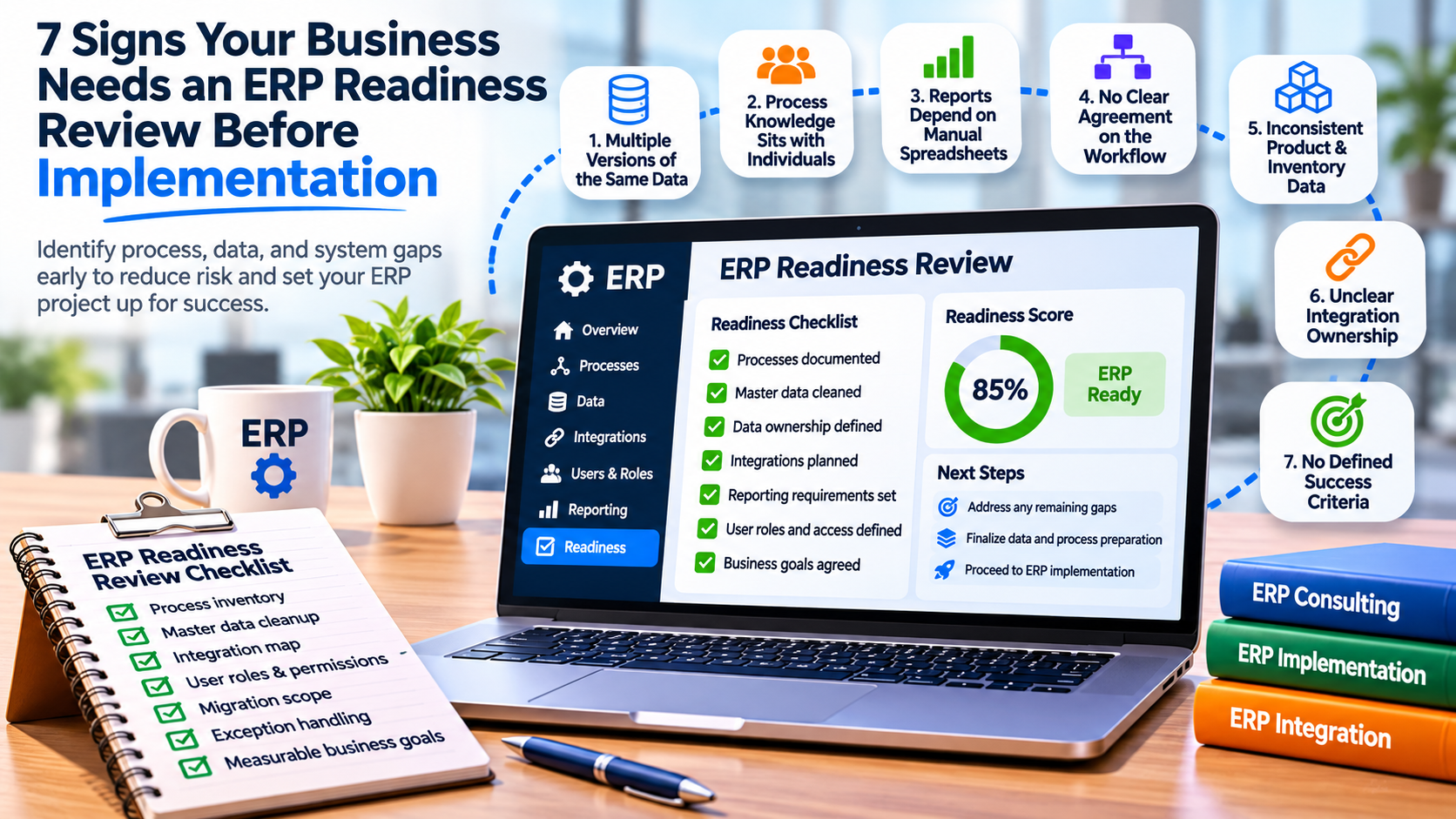
ERP projects often begin with software selection.
Teams compare platforms, features, modules, implementation timelines, integrations, and pricing.
The condition of the business processes entering the new system deserves equal attention.
Poor data, inconsistent workflows, unclear ownership, and disconnected applications can follow the company into the new ERP if those issues are not addressed early.
Businesses considering ERP Services with Consulting, Integration and AI can reduce implementation risk by reviewing operational readiness before configuration and migration begin.
Here are seven signs that an ERP readiness review should come first.
Sales has one customer list.
Finance has another.
Operations maintains a spreadsheet.
Warehouse teams use a separate inventory record.
When the same information exists in several places, migration becomes harder.
Before ERP implementation, identify which system currently owns important information such as:
Customers
Suppliers
Products
Inventory
Orders
Payments
Employees
Then decide which values should become authoritative inside the ERP.
Without this step, duplicate and conflicting records can enter the new system immediately.
Many organizations have processes that work because one experienced employee knows what to do next.
For example:
A purchase request arrives.
Someone knows which manager should approve it.
Another employee remembers which supplier to contact.
Finance knows which spreadsheet needs updating.
This knowledge may never be formally documented.
ERP implementation requires these processes to become clear enough for software to support them.
Map the current workflow before configuring automation.
Document:
Trigger
Responsible person
Approval
Required information
Next action
Exception process
This reduces dependence on individual memory.
Management reporting can reveal ERP readiness issues quickly.
If employees regularly export information, clean it manually, combine several spreadsheets, and calculate totals before a meeting, the underlying data structure needs attention.
Common causes include:
Different naming conventions
Missing fields
Duplicate records
Inconsistent categories
Separate systems
Manual calculations
Define the reports leadership needs after implementation.
Then identify which data must exist inside the ERP to produce those reports reliably.
Ask three employees how an order moves through the business.
If you receive three different answers, configuration should wait.
ERP systems require clear process definitions.
For example, an order process may involve:
Order received
↓
Credit check
↓
Inventory confirmed
↓
Approval
↓
Fulfillment
↓
Invoice
↓
Payment
Each stage needs clear responsibility and rules.
A readiness review helps teams agree on the real process before software starts enforcing it.
ERP implementations depend heavily on clean master data.
Product information may contain:
Duplicate SKUs
Different naming conventions
Missing categories
Incorrect units
Old pricing
Inactive products
Supplier inconsistencies
Inventory can create additional problems when warehouse records and accounting records do not match.
Clean product, supplier, and stock information before migration.
This gives the new ERP a more reliable starting point.
Most ERP systems connect with other applications.
These may include:
CRM
Ecommerce
Payroll
Banking
Warehouse systems
Customer portals
Shipping platforms
Each integration needs clear ownership rules.
For example:
CRM
Owns sales opportunities and relationship activity.
ERP
Owns orders, procurement, inventory, and operational transactions.
Finance
Owns approved accounting records and payment status.
When ownership is unclear, systems can overwrite one another.
Define this before integration work begins.
An ERP implementation should solve measurable business problems.
Examples include:
Faster order processing
Better inventory accuracy
Shorter month end reporting
Less manual data entry
Faster purchasing approvals
Better supplier visibility
Reduced duplicate records
Without clear outcomes, the project can become a long list of configuration tasks.
Define several measurable goals before implementation begins.
Those goals should guide scope and priorities.
Create a list of the major processes the ERP will support.
Typical areas include:
Sales orders
Procurement
Inventory
Finance
Warehousing
Manufacturing
Customer management
Supplier management
Reporting
For each process, document the current workflow and the desired future workflow.
This helps identify unnecessary steps before they become part of the new ERP.
Master data affects almost every ERP module.
Review:
Duplicates, addresses, payment terms, status.
Contact information, terms, active relationships.
SKU, description, category, unit, cost, price.
Roles, departments, approvals.
Warehouse, location, quantity, valuation.
Data cleanup often requires business input, so starting early gives teams more time to resolve questions.
Create an integration map before development begins.
For every connected system, document:
Information exchanged
Direction of data
Frequency
Data owner
Failure handling
Duplicate prevention
This prevents integration requirements from appearing late in the project.
ERP access should reflect responsibilities.
Typical groups may include:
Sales
Finance
Procurement
Warehouse
Operations
Management
For each group, define what they need to view, create, approve, and modify.
Clear role planning improves usability and supports stronger access control.
Not every historical record needs to enter the new ERP.
Separate data into:
Migrate
Required for current operations.
Archive
Needed for historical reference.
Transform
Useful after cleanup or restructuring.
Retire
No longer needed.
This can reduce migration complexity significantly.
Normal workflows receive most of the attention during ERP planning.
Real operations also include exceptions.
Examples include:
Order exceeds credit limit
Inventory unavailable
Supplier delivery late
Invoice mismatch
Approval delayed
Integration fails
Define how each important exception should be handled.
The ERP should make unusual cases visible so employees know when action is required.
A simple readiness review can assess these areas:
| Area | Question |
|---|---|
| Processes | Are key workflows clearly documented? |
| Data | Is master data accurate and consistent? |
| Ownership | Does each important value have an owner? |
| Integrations | Are system connections understood? |
| Reporting | Are management reporting requirements clear? |
| Users | Are roles and permissions defined? |
| Goals | Are measurable implementation outcomes agreed? |
Weak areas should be addressed before major configuration starts.
Many ERP problems begin before the software is configured.
Unclear workflows create unnecessary customization.
Poor data creates migration problems.
Undefined ownership creates integration conflicts.
Weak success criteria create scope confusion.
A readiness review gives the implementation team a clearer operational foundation.
When processes, data, ownership, integrations, roles, and business goals are defined early, ERP implementation becomes easier to scope, test, and manage.
That preparation can reduce expensive changes later and help the new system support how the business actually operates.