English
 Arabic
 French
 Spanish
 Portuguese
 Deutsch
 Turkish
 Dutch
Dutch
 Italiano
 Russian
 Romaian
 Portuguese (Brazil)
 Greek
Greek
How Cognitive Robotics is Reshaping the US Market Dynamics
Other |
2026-09-24 09:49:13
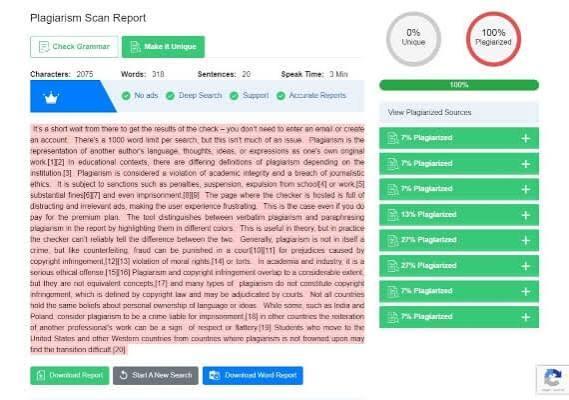
A plagiarism detector is a software tool that helps identify similarities between a piece of writing and other documents or online sources. It is widely used in education, publishing, content marketing, research, and professional writing.
As online information continues to grow, checking the originality of written material has become an important part of the editing process. However, using a plagiarism detector correctly requires an understanding of what its results actually mean.
A plagiarism detector analyzes text and searches for matching or similar content in sources accessible to the system.
The user generally pastes text into an online interface or uploads a document. After processing, the software may identify sentences or phrases that resemble material found elsewhere.
Some tools provide a similarity percentage, while others show individual matches and source references.
The technology behind these systems differs. Some primarily identify exact phrases, while others use more sophisticated techniques to recognize similar sentence patterns.
Students commonly use plagiarism detection software before submitting assignments. It can help them discover passages that need quotation marks, citations, or rewriting.
Teachers and educational institutions may also use plagiarism detection as part of academic review.
Outside education, businesses use these tools to inspect articles, reports, website pages, product descriptions, and marketing materials.
Publishers and editors can use them as one step in their quality-control process.
A typical plagiarism detector divides a document into phrases or sections and compares those sections against its available information sources.
When a potential match is found, the software may highlight the relevant text.
For example, if a sentence contains several words in the same sequence as a published webpage, the system may identify that webpage as a possible source.
More advanced systems can also look for similar phrasing even when the wording has been changed.
A similarity score should be interpreted carefully.
A score does not automatically tell you how much of the content is plagiarized. It indicates how much text appears similar to material in the tool's comparison database.
A report can contain matches that are completely legitimate.
Direct quotations may produce matches because they intentionally reproduce the source's exact wording. Bibliographies and common terminology can also increase similarity.
Therefore, the highlighted sections and their context are usually more useful than the overall percentage alone.
The best way to avoid accidental plagiarism is to develop good research habits.
When reading a source, first understand the author's main idea. Then close the source and explain that idea independently. If the exact wording is important, keep it as a quotation and provide appropriate attribution.
Writers should also keep accurate records of sources during research.
This approach is more effective than taking an existing paragraph and replacing a few words with synonyms.
Website content needs careful attention because search engines can access a large amount of published material.
When creating an article around a target keyword, writers should develop an original structure, use their own explanations, add useful details, and avoid copying competitor headings or paragraphs.
A plagiarism checker can then identify passages that may need additional editing.
However, originality should never mean removing useful facts simply because another website has discussed them. Facts and topics can be shared; what matters is how the information is researched, explained, attributed, and presented.
A plagiarism detector cannot compare content against every piece of writing that exists.
Some private documents, newly published pages, books, or restricted databases may not be accessible to the software. Detection accuracy also varies between providers.
For that reason, a clean report should not be interpreted as an absolute guarantee that no similar wording exists anywhere.
Human review remains important.
A plagiarism detector is a helpful editing tool for anyone who works with written content. It can identify potential similarities and give writers an opportunity to improve their work before submission or publication.
The strongest approach combines independent writing, proper source management, accurate citations, careful editing, and automated plagiarism detection. When used this way, a detector becomes a practical quality-control tool rather than a simple percentage generator.
See more blogs: Visit Here