English
 Arabic
 French
 Spanish
 Portuguese
 Deutsch
 Turkish
 Dutch
 Italiano
 Russian
 Romaian
 Portuguese (Brazil)
 Greek
Commercial Countertop Blenders Market and the Future of Food Preparation
Other |
2026-10-14 10:51:48
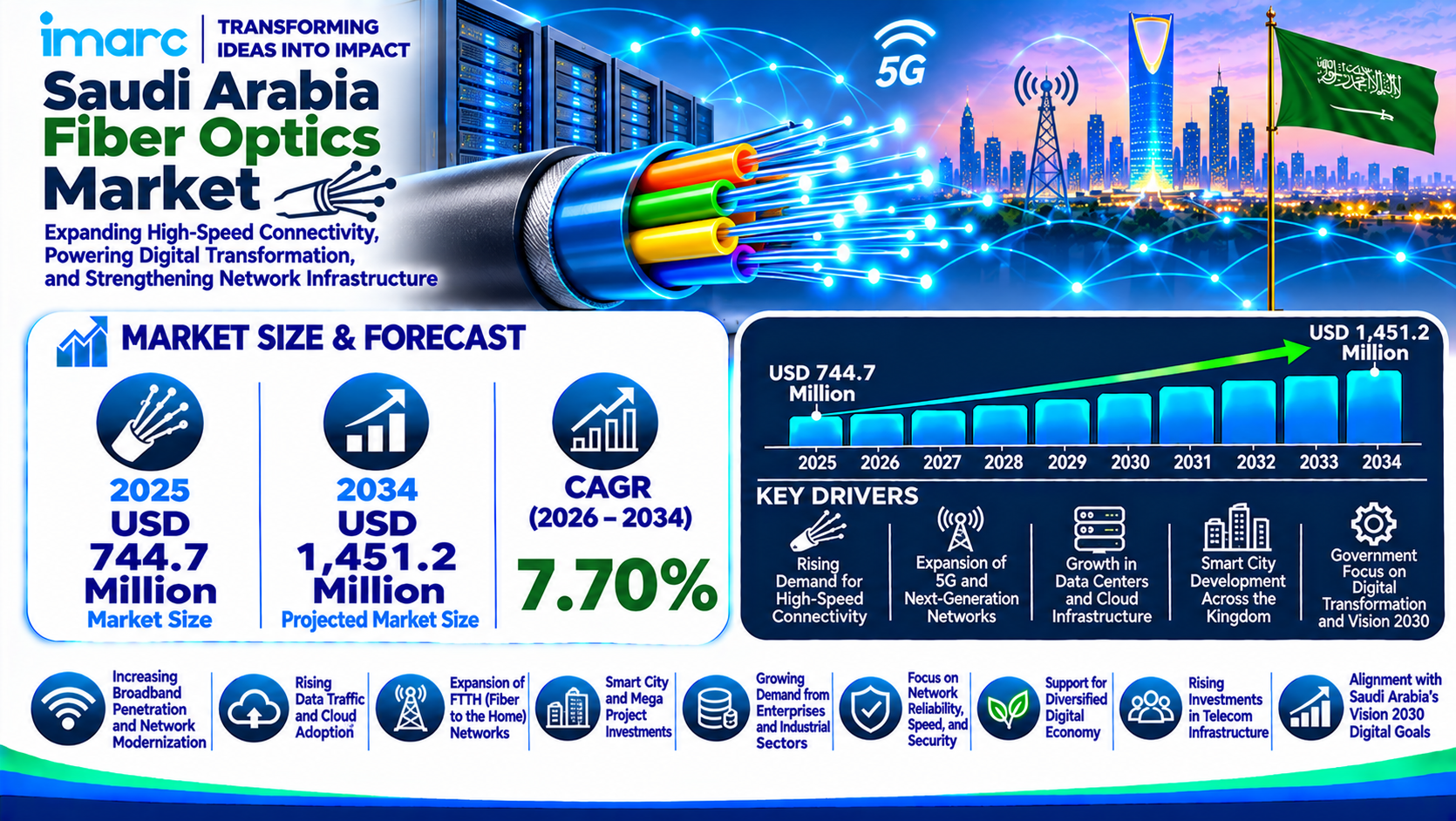
IMARC Group, a leading global market research and management consulting firm, has published its latest market intelligence report on the Saudi Arabia fiber optics market. The Saudi Arabia fiber optics market size reached USD 744.7 Million in 2025 and is projected to reach USD 1,451.2 Million by 2034, exhibiting a CAGR of 7.70% during 2026-2034, driven by Vision 2030 digital transformation, expanding cloud and data center infrastructure, and rising demand for high-speed broadband connectivity.
Fiber networks are becoming the backbone of Saudi Arabia's digital economy, with telecom operators, data center developers, and government agencies all competing for scarce high-capacity bandwidth. Three structural forces are shaping this trajectory: nationwide shared neutral-host infrastructure rollouts that lower per-operator deployment costs, a historic wave of hyperscale data center and AI workload connectivity demand, and continued regulatory support from Vision 2030-aligned digital infrastructure programs.
Saudi Arabia Fiber Optics Market at a Glance:
How AI is Reshaping the Future of the Saudi Arabia Fiber Optics Market
Grab a sample PDF of this report: https://www.imarcgroup.com/saudi-arabia-fiber-optics-market/requestsample
Saudi Arabia Fiber Optics Market Trends and Drivers:
Long-haul and metro network expansion is the foundational driver behind Single Mode cable's dominant 71.8% share, as telecom operators and infrastructure providers prioritize high-bandwidth, low-loss transmission for backbone connectivity across the Kingdom. Glass optical fiber complements this trend with its 82.6% share, reflecting telecom and data center operators' continued preference for superior transmission performance and durability over plastic alternatives. Multi-Mode cables, meanwhile, retain a meaningful presence in data center interconnects and shorter-distance enterprise networks, where simplified and cost-effective connectivity remains the priority for facility-level deployments.
Regional telecom infrastructure investment is compounding this cable and fiber-type led growth, with concentrated momentum in the Northern and Central Region, home to Riyadh's dense telecom operator base and growing data center cluster. Nokia's partnership with ACES-NH to deploy the Kingdom's first shared neutral-host fiber network, alongside stc's continued fiber-to-the-home rollout, illustrates how shared infrastructure models are accelerating nationwide coverage while lowering per-operator capital costs. The Eastern Region follows with a sizable share tied to industrial connectivity demand, while the Western Region benefits from tourism-linked telecom investment around Jeddah and the pilgrimage corridor.
Hyperscale data center expansion and the integration of terrestrial and non-terrestrial networks are reshaping distribution economics on top of these demand drivers. Dependence on imported glass fiber, connectors, and specialized manufacturing components continues to expose the market to global supply chain disruptions, while trenching and right-of-way costs constrain fiber penetration in lower-density regions. At the same time, a shortage of trained technicians for precision splicing and testing is prompting operators to invest in dedicated training academies, even as competition from 5G and satellite broadband services moderates fiber demand in select remote geographies.
Government Schemes and Vision 2030 Initiatives Driving Demand:
Saudi Arabia Fiber Optics Industry Segmentation:
The report has segmented the market into the following categories:
Breakup By Cable Type:
Single Mode cables command a 71.8% majority share in 2025, reflecting their suitability for long-haul, metro, and backbone network deployment across the Kingdom's expanding telecom infrastructure. Multi-Mode cables hold the remaining 28.2%, serving data center interconnects and shorter-distance enterprise network applications that prioritize simplified, cost-effective connectivity.
Breakup By Optical Fiber Type:
Glass optical fiber leads at 82.6% share in 2025, owing to superior transmission distance, lower attenuation, and durability that make it the dominant choice for telecom, data center, and long-haul deployments. Plastic optical fiber holds the remaining share, serving cost-sensitive, short-distance applications including industrial automation and select in-building connectivity use cases.
Breakup By Application:
Telecom applications anchor demand across the Kingdom, supported by nationwide broadband rollout, data center connectivity, and enterprise digital transformation, while Oil and Gas, Military and Aerospace, BFSI, Medical, and Railway applications contribute steady, specialized demand for ruggedized and high-reliability fiber solutions across the Kingdom's industrial and institutional networks.
Breakup By Region:
The Northern and Central Region commands 40.9% share in 2025, driven by Riyadh's concentrated telecom infrastructure and government digital initiatives. The Eastern Region follows at 26.8%, supported by industrial connectivity demand, while the Western Region holds 21.1% on strong commercial and tourism-linked telecom demand, and the Southern Region's 11.2% share reflects emerging connectivity initiatives and growing digital inclusion programs.
Competitive Landscape:
The Saudi Arabia fiber optics market is moderately concentrated, with global cable manufacturers supplying fiber cables alongside domestic telecom operators and infrastructure contractors executing deployment programs. The report provides detailed profiles of all major companies, including:
Corning Incorporated and Nexans lead global optical fiber and cable manufacturing supply into the Kingdom, while stc leads national fiber broadband deployment and digital infrastructure investment. Competition is shaped by technology partnerships, network deployment contracts, and Vision 2030-aligned infrastructure investment programs rather than price alone.
Market Concentration Analysis:
What Does The Full Report Cover?
If you are tracking the Saudi Arabia fiber optics market for investment decisions, market entry planning, competitive benchmarking, or strategic advisory, IMARC Group's report gives you everything in one place:
Recent News and Developments in Saudi Arabia Fiber Optics Market
Note: If you require specific details, data, or insights that are not currently included in the scope of this report, we are happy to accommodate your request. As part of our customization service, we will gather and provide the additional information you need, tailored to your specific requirements. Please let us know your exact needs, and we will ensure the report is updated accordingly to meet your expectations.
Key Questions This Report Answers
About Us
IMARC Group is a global management consulting firm that helps the world's most ambitious changemakers to create a lasting impact. The company provides a comprehensive suite of market entry and expansion services. IMARC offerings include thorough market assessment, feasibility studies, company incorporation assistance, factory setup support, regulatory approvals and licensing navigation, branding, marketing and sales strategies, competitive landscape and benchmarking analyses, pricing and cost research, and procurement research.
Media and Sales Contact
IMARC Group
Email: sales@imarcgroup.com
United States: +1-201-971-6302
India: +91-120-433-0800
United Kingdom: +44-753-714-6104